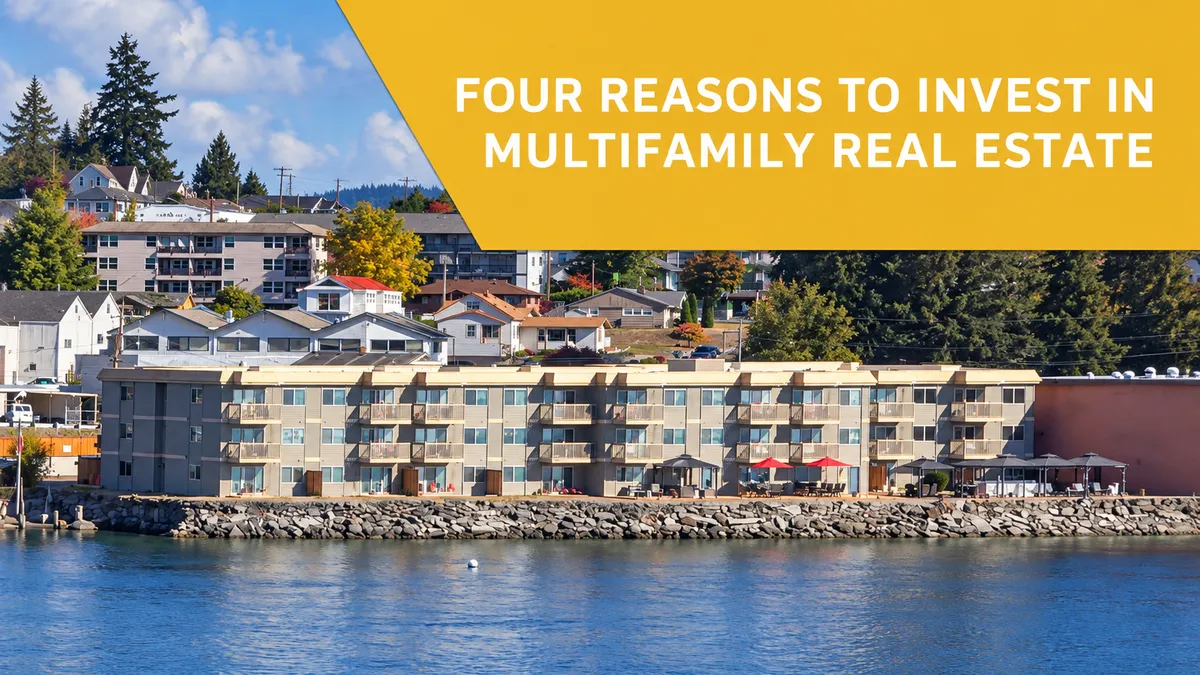
Four Reasons to Invest in Multifamily Real Estate
Four Reasons to Invest in Multifamily Real Estate
As an engineer, I've spent much of my career focused on solving problems, developing technology, and building things that work. It's rewarding work, and engineering can provide an excellent income. But I've also learned that earning a good salary and having financial freedom are two very different things.
A high income provides opportunities, but when your lifestyle depends entirely on your paycheck, your choices can become limited. Changing careers, joining a startup, or pursuing an idea you're passionate about becomes more difficult when you have a family and financial responsibilities.
That's one of the reasons I became interested in multifamily real estate.
I wanted to build income that wasn't directly tied to the hours I worked. More importantly, I wanted to own assets that could continue producing income regardless of what I chose to do professionally.
Multifamily real estate offers four primary financial benefits that make it worth understanding: cash flow, appreciation, tax advantages, and inflation resistance.
Each serves a different purpose, and together they can create a powerful foundation for long-term financial independence.
1. Cash Flow: Income Without Trading Your Time
Cash flow is the primary reason I invest in multifamily real estate.
When an apartment building collects rent, that income pays for the property's operating expenses, including maintenance, insurance, taxes, and management. After covering those expenses, debt payments, and appropriate reserves, the remaining cash may be available for distribution to investors.
The benefit is straightforward. A well-performing property can provide recurring income without requiring every investor to work at the property or manage its daily operations.
For someone with a demanding career, this is particularly valuable.
Most engineers understand the relationship between time and money. We work, we receive a paycheck, and that income supports our families and lifestyles. Even with a great salary, there's a limit to how much time we can work.
Cash-flowing investments provide an opportunity to change that relationship.
Imagine building enough monthly investment income to cover a meaningful portion of your household expenses. You might not need to replace your entire salary to make a significant difference in your life.
Maybe that additional income allows you to accept a position with a company whose mission you believe in, even if the salary is lower. Perhaps it gives you the confidence to join an early-stage startup or spend time developing an idea of your own.
The purpose isn't necessarily to stop working. It's to have more freedom to decide what kind of work you want to do.
Of course, positive cash flow isn't guaranteed. Properties experience vacancies, unexpected repairs, and changes in operating costs. This is why purchasing at the right price, using appropriate financing, and maintaining responsible reserves are so important.
But when a property is purchased and operated correctly, recurring cash flow can become an important source of financial independence.
2. Appreciation: Building Wealth Through Ownership
The second benefit is appreciation, or the increase in a property's value over time.
Real estate can appreciate as communities grow, housing demand increases, and the cost of constructing new properties rises. However, commercial real estate has another important characteristic: its value is closely connected to the income it produces.
This gives property owners opportunities to influence the value of their investments through better operations.
For example, consider an apartment building where improvements in management, occupancy, or operating efficiency increase annual net operating income (NOI) by $25,000.
At a 5% capitalization rate, that additional income could support approximately $500,000 in additional property value.
The calculation is relatively simple:
$25,000 ÷ 0.05 = $500,000
This is one of the reasons I like commercial real estate. Owners can increase the value of their properties by improving how the underlying business operates, rather than relying entirely on market appreciation.
It's important to understand that values can also decline. Changes in interest rates, capitalization rates, market conditions, and operating performance all influence what a property is worth.
Appreciation also differs from cash flow because the increase in value generally isn't money in your pocket until the equity is accessed through a sale or refinancing.
Still, the ability to build equity while holding an income-producing asset is an important component of long-term wealth creation.
3. Tax Advantages: Keeping More of What You Earn
Taxes are another important consideration when investing in real estate.
The tax code recognizes that rental properties are businesses with operating expenses and physical assets that wear out over time.
Property owners can generally deduct eligible operating expenses, mortgage interest, and depreciation when calculating taxable rental income.
Depreciation is particularly interesting because it's a noncash expense.
The IRS allows investors to deduct the cost of qualifying buildings and improvements over established depreciation periods. That deduction can reduce taxable income even though the property may continue generating positive cash flow.
For example, a property could distribute cash to its investors while depreciation and other allowable deductions reduce the amount of taxable income reported from the investment.
This doesn't mean the distributions are automatically tax-free. Tax treatment depends on the investment structure, each investor's circumstances, and applicable tax rules. Passive activity loss limitations can also prevent investors from using real estate losses to offset their W-2 income.
Depreciation can have tax consequences when a property is sold, so it's important to evaluate the entire investment rather than focusing only on annual deductions.
For high-income professionals, understanding these differences matters.
It's not simply about how much an investment earns. It's also about how much of that return you ultimately retain after taxes.
I view tax advantages as an additional benefit of a fundamentally sound investment, not a reason to purchase a property that otherwise doesn't make financial sense.
4. Inflation Resistance: Owning Assets in a Changing Economy
Inflation gradually reduces the purchasing power of money.
A dollar today doesn't purchase what it did twenty years ago, and we can reasonably expect the cost of goods and services to continue changing throughout our lifetimes.
Multifamily real estate has characteristics that can help investors respond to inflation.
Housing is an ongoing necessity. As wages, construction costs, and the general cost of living increase, market rents may also rise over time.
Unlike some commercial properties with leases extending for many years, most apartment leases are relatively short. This allows owners to adjust rents periodically as leases renew, provided local market conditions support those increases.
Another potential advantage involves financing.
When a property is purchased using long-term, fixed-rate debt, the principal and interest payment remains the same even as the purchasing power of the dollar changes.
If rental income increases over time while the fixed debt payment remains constant, more income may become available to support the property and its investors.
However, inflation also increases expenses. Insurance, property taxes, utilities, repairs, and labor costs can rise faster than rents. Market competition and local regulations may also limit rental increases.
Real estate isn't immune to inflation, but a well-located, responsibly financed property can offer some protection against its long-term effects.
The Value of Owning Something Real
Beyond these four financial benefits, there's another characteristic of multifamily real estate that I find particularly important.
It's a physical asset that serves an ongoing need.
An apartment building isn't just a number in an investment account. It's land, buildings, and homes that people use every day.
Financial markets fluctuate. Businesses evolve, industries change, and technologies eventually become obsolete. But people will continue to need places to live.
That doesn't mean every apartment building will be profitable or that physical assets cannot lose value. Buildings require maintenance, good management, and ongoing investment. Poor financial decisions can put even a desirable property at risk.
But a well-maintained apartment building in a market with lasting housing demand has the potential to continue producing income for decades.
And unlike an asset that must be sold to realize any financial benefit, an income-producing property can provide cash flow while you continue to own it.
That's a distinction I find particularly valuable.
Building Wealth Is Only Part of the Goal
Cash flow, appreciation, tax advantages, and inflation resistance each contribute something different to real estate ownership.
Cash flow provides the opportunity for recurring income. Appreciation can build equity over time. Tax advantages can improve after-tax results. Inflation resistance can help maintain the economic value of an investment over the long term.
Together, these characteristics make multifamily real estate worth considering as part of a long-term investment strategy.
But for me, the bigger objective isn't simply accumulating more assets or watching an investment account grow.
It's creating choices.
I've met plenty of talented engineers who have ideas they would love to pursue, companies they would like to build, or work they would find more meaningful. Often, the biggest obstacle isn't their ability or experience. It's the financial responsibility that comes with stepping away from a dependable salary.
My goal is to help engineers understand how cash-flowing multifamily investments can contribute to changing that equation.
Not every investment will be right for every person, and real estate comes with risks that need to be understood. Building financial independence requires patience, disciplined decisions, and a willingness to learn.
But the underlying objective is simple.
Build assets that produce income so your paycheck doesn't have to make every decision for you.
Because financial freedom isn't necessarily about retiring early or never working again.
It's about having the freedom to choose the work you believe in.
